

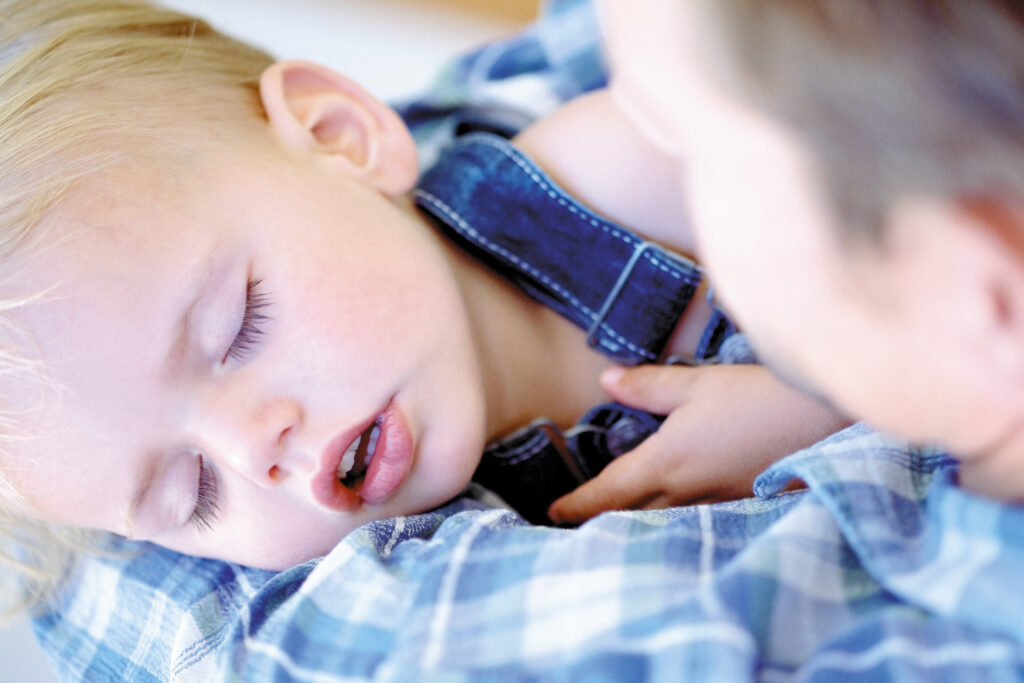
Hearing your child snore for the first time is unsettling, but it’s also extremely common — an estimated 1 in 10 children snores at night, and up to 20% will snore at some point. Child snoring isn’t automatically a red flag. What matters is the pattern: how often it happens, what it sounds like, and what else comes with it.
This article is for general education and isn’t a substitute for an in-person medical or dental evaluation.
Occasional Snoring vs. Frequent Snoring
Snoring happens when airflow through the nose and throat is partially blocked during sleep, causing nearby tissue to vibrate. Occasional snoring — during a cold, a rough allergy week, or an isolated night — is common and usually resolves as congestion clears. It generally doesn’t need to be evaluated on its own.
Snoring in children that happens most nights, regardless of illness, is a different pattern. Frequency, rather than a single loud night, is one of the more useful things to pay attention to when deciding whether snoring is worth mentioning to a provider.
| Occasional Snoring | Frequent Snoring | |
|---|---|---|
| Timing | Tied to a cold, allergies, or illness | Happens most nights, illness or not |
| Sound | Light, quiet | Loud, or sounds effortful/labored |
| Breathing pattern | Steady | May include pauses, gasping, or choking sounds |
| Typically resolves | Yes, as congestion clears | Not necessarily — may persist |
The Mouth Breathing Connection
Snoring rarely shows up on its own. Many children who snore also breathe through their mouth, both during sleep and sometimes during the day. This isn’t a coincidence — the same airway narrowing that produces snoring often pushes a child toward mouth breathing as well, since it can feel easier than breathing through a partially obstructed nose. Chronic mouth breathing is worth noting alongside snoring, since together they suggest a more consistent airway pattern rather than an isolated nighttime noise.
Restless Sleep
Snoring often travels with restless sleep — tossing and turning, unusual sleep positions, or frequent brief awakenings that a parent may not fully register happening. This combination matters because it suggests sleep quality may be affected, not just that a sound is present. A child can be in bed for a full night and still not get consistently restful sleep if their breathing is being disrupted throughout it.
Possible Airway Concerns
It’s important to be measured here: most children who snore do not have a serious underlying condition, and snoring alone does not confirm a sleep-related breathing problem. That said, in some children, frequent snoring may be associated with underlying airway-related factors — including enlarged tonsils or adenoids, chronic nasal congestion or allergies, or jaw and palate structure that leaves less room for the airway. These are possibilities worth investigating when the pattern is frequent and persistent, not conclusions to assume from snoring by itself.
What Parents Can Observe
Before bringing up snoring at an appointment, it can help to note a few specific things:
- How many nights per week the snoring happens
- Whether it sounds light and steady, or loud and effortful
- Whether you’ve noticed pauses in breathing, gasping, or choking sounds
- Whether your child also breathes through their mouth during the day
- Daytime patterns — unusual tiredness, irritability, trouble focusing, or the opposite: being “tired but wired” and unusually wound up
- Any recent changes in weight gain, growth, or behavior
These specific observations are far more useful to a provider than a general impression that “something seems off.”
When Professional Evaluation May Be Appropriate
Snoring that happens most nights, sounds loud or labored, includes witnessed pauses in breathing, or comes with daytime fatigue, irritability, or trouble concentrating is reasonable to bring to your pediatrician. A pediatrician can assess your child directly and determine whether a referral — commonly to an ENT for tonsil or adenoid evaluation, or for a sleep study — is appropriate.
Because jaw structure, palate development, and tongue posture can also play a role in airway-related snoring, a dental airway evaluation can be a useful complementary step. At West U Pediatric Dentistry, we incorporate a validated screening tool called FAIREST-6 into routine exams specifically to help identify whether findings like these warrant a closer look. It’s worth being clear about what this can and can’t do: a dental screening may identify risk factors worth investigating further, but it does not diagnose a sleep disorder, and it doesn’t replace a medical evaluation when one is indicated. Learn more about how this screening works on our Airway & Sleep Screening page.
If screening or a medical evaluation points to jaw growth, palate width, or tongue posture as a contributing factor, our Airway Orthodontics page covers the treatment approaches we may recommend as part of a coordinated plan — always alongside, not in place of, medical care when a diagnosis is needed.
Frequently Asked Questions
Is it normal for my child to snore sometimes? Yes. Occasional snoring, especially during a cold or allergy flare, is common in children and typically isn’t a sign of a serious problem on its own.
How do I know if my child’s snoring needs to be checked out? Snoring that happens most nights, sounds loud or effortful, includes pauses in breathing, or comes with daytime fatigue or behavior changes is worth discussing with your pediatrician.
Can a dentist diagnose why my child is snoring? No. A dental airway screening can help identify structural or functional findings — like jaw or palate development — that may be worth investigating further, but diagnosing the cause of snoring, including sleep apnea, requires a medical evaluation.
Does snoring always mean my child has sleep apnea? No. Most children who snore do not have sleep apnea. Snoring becomes more concerning when it’s frequent, loud, or paired with breathing pauses and daytime symptoms.
Getting Started
If your child’s snoring happens regularly, or comes with mouth breathing, restless sleep, or daytime changes, start with your pediatrician for a medical evaluation, and consider a dental airway screening to look at jaw, palate, and tongue-related factors as part of the fuller picture. Learn more on our Airway & Sleep Screening page, or schedule an appointment with West U Pediatric Dentistry, serving families throughout West University, Houston, and the surrounding communities.
References
- Cleveland Clinic. Does Your Child Snore? These Could Be the Reasons Why. Cleveland Clinic Health Library. https://health.clevelandclinic.org/does-your-child-snore-signs-of-trouble
- Pediatric Obstructive Sleep Apnea: Diagnostic Challenges and Management Strategies. PMC, National Library of Medicine. https://pmc.ncbi.nlm.nih.gov/articles/PMC11649035/